

 Lobectomy, the standard of care for lung cancer today, has been traditionally performed via open thoracic surgery, an invasive approach involving a week in hospital and months of recovery at home. Open thoracic surgery results in a larger wound, more pain, a longer hospital stay and more complications in the weeks that follow. The results of this have been reported internationally in a large NIHR-funded randomised trial (VIOLET) led by Professor Eric Lim.
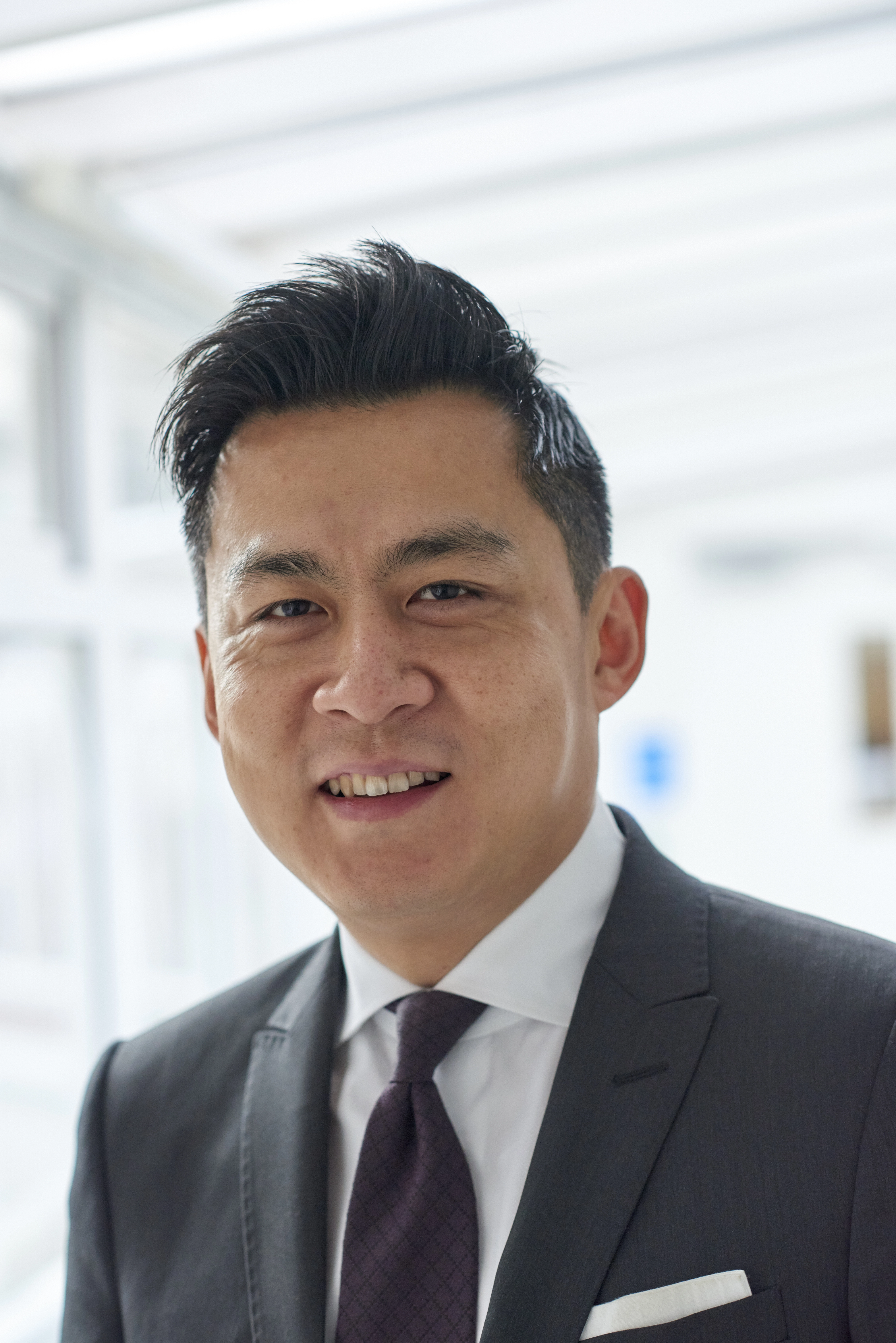
Recent innovations by Professor Lim in the field of minimally invasive thoracic surgery have led to lobectomies being carried out through a single keyhole incision, with good pain control and without chest drains, resulting in a lobectomy patient returning home on the same day as the procedure. Learn more from Professor Eric Lim, consultant thoracic surgeon at Royal Brompton Hospital, who performed this world first surgery.
Evolution of minimally invasive thoracic surgery
Professor Lim has extensive expertise in surgery for lung cancer, commonly performing lung resections, both as day cases and involving overnight stays. He has been performing minimally invasive thoracic surgeries for over 15 years, making huge advancements to improve the process.
In 2016, Professor Lim successfully achieved drain free day case surgery for wedge resection, rather than for lobectomy which is a more complex procedure. It wasn’t until 2 years ago that he reduced hospital stays for lobectomies to just 1-2 days. This breakthrough led him to believe that same-day discharge for lobectomy could become a real possibility.
“There’s a Japanese concept called Kaizen which is to make small incremental improvements throughout your whole life,” explains Professor Lim. “And, unknowingly, this is what we were doing as a team – continuing to make small improvements to our drain care and pain management over a number of years.”
Day case surgery is now a common occurrence in thoracic surgery for Professor Lim and his team, with the entire surgery list often returning home on day zero. At Royal Brompton Hospital, in addition to our recently demonstrated day case lobectomy procedure, we’re proud to offer day surgery for thoracic procedures including:
- lobectomy
- lung biopsy
- mediastinal surgery
- pleural effusion surgery
- pleural biopsy
- pneumothorax surgery
Video-assisted thoracoscopic surgery (VATS)
Video-assisted thoracoscopic surgery (VATS) is a minimally invasive technique used to treat lung cancer, including complex cases. Performed through small incisions without rib spreading, VATS allows faster recovery, reduced pain, and minimal scarring compared to traditional open surgery. Specialists at Royal Brompton Hospital often use a single port VATS approach, which has shown excellent outcomes, even in high-risk patients, making surgery possible for individuals previously deemed inoperable elsewhere.
Professor Lim was a pioneer in establishing the VATS programme for lung cancer at Royal Brompton Hospital. He now performs the majority of his operations using a camera and keyhole instruments through a single 3cm incision, improving patient recovery and outcomes.
Further to this, our specialists at Royal Brompton work closely with the Royal Marsden Hospital in the care of lung cancer patients, providing multidisciplinary care when it comes to both medical and surgical therapies.
The role of drain management
Aside from complications and social issues, the most important factors that can affect the length of hospital stay are pain levels and the duration of the drain. Ultimately, discharge time depends on how drainage of fluid, blood and air at the operation site is managed, without collapsing the lung. As this needs to be managed so carefully, it has taken years for Professor Lim and his team to slowly increase the amount that can be left undrained, closely assessing each operation for risks.
“When we started, we always put drains in for all patients but we never knew how much fluid the body could tolerate,” says Professor Lim. “So, year by year, we increased the fluid threshold incrementally, reaching the point where we were able to take drains out without regard to how much fluid there was, because we understood that the body can actually cope with the vast majority of fluid that it produces.”
This means that the only limiting factor is air leak, however, the team now uses digital drains to track this, allowing them to know the precise moment when air leak stops. “Now my practice is, we don’t need to drain if we know the patient doesn’t have an air leak after the operation,” explains Professor Lim.
Based on these advancements, he implemented a protocol where the drain can be safely removed while the patient is still in the operating room. This allows pain to be far better controlled, with a paper published by Professor Lim showing that only 1% of his patients required a drain to be reinserted.
Managing pain in day case patients
Pain management links very closely with drain and incision management. “Pain is far better controlled without a drain, and I believe we can control pain with a single incision much better than if we were to use many incisions,” explains Professor Lim. With 70% of all his procedures carried out through a single keyhole incision, pain levels among his patients are low enough that day zero discharge is becoming increasingly common.
The VIOLET (VIdeo assisted thoracoscopic lobectomy versus conventional Open LobEcTomy for lung cancer) study, led by Professor Lim, recruited participants with known or suspected early-stage lung cancer and looked at the longer-term outcomes of pain control with single incision VATS. “In hospital, there’s no difference because the nurses are controlling patients’ pain,” says Professor Lim. “However, once they leave hospital, we found that single incision patients have lower pain scores compared to multiple keyhole incisions and are much more mobile during the first 3-6 months.”
As pain control is one of the key factors that influences whether patients go home on the same day as surgery, Professor Lim aims to offer minimally invasive surgery to as many patients as possible. “I start out almost all my operations minimally invasively on the possibility that I can do it, and then convert around 25% to open surgery,” he explains. “I don’t select the patients I start out with because I want to give every patient the chance of a quicker recovery, if possible.”
Transforming care through collaborative innovation
In October 2024, Professor Lim successfully discharged a lobectomy patient on day zero, demonstrating proof of concept that thoracic surgery can be performed as a day case. “Lobectomy is one of the most demanding operations,” says Professor Lim, “which means that anything less invasive than a lobectomy could technically be done as a day case.” However, patient comfort is also crucial and it’s important to recognise that not all patients feel comfortable with the idea of going home on the same day.
When it comes to facilitating day cases, Professor Lim highlights the importance of teamwork. “I always tell the team that surgical aspects are about 20%, while logistics and administrative aspects are 80%,” he notes. “All of that needs to come together in time for us to successfully discharge a patient on the same day so, in this case, the whole hospital worked together to achieve a world first.”
When to refer to us
Patients requiring treatment for lung and chest cancer can be referred to our team of specialists at Royal Brompton Hospital. Our team will assess each patient’s suitability for minimally-invasive surgery and, while it is preferable that each patient undergoes the least invasive procedure possible, it is important to note that it may not be in every patient’s best interest. In these cases, Professor Lim and his team can see patients for traditional open thoracotomies instead.
Get in touch
To find out more about day case thoracotomy procedures for patients requiring chest surgery, including treatment for advanced-stage lung cancer, please contact our customer service team. Call +44 (0)20 3131 5130 or email [email protected].